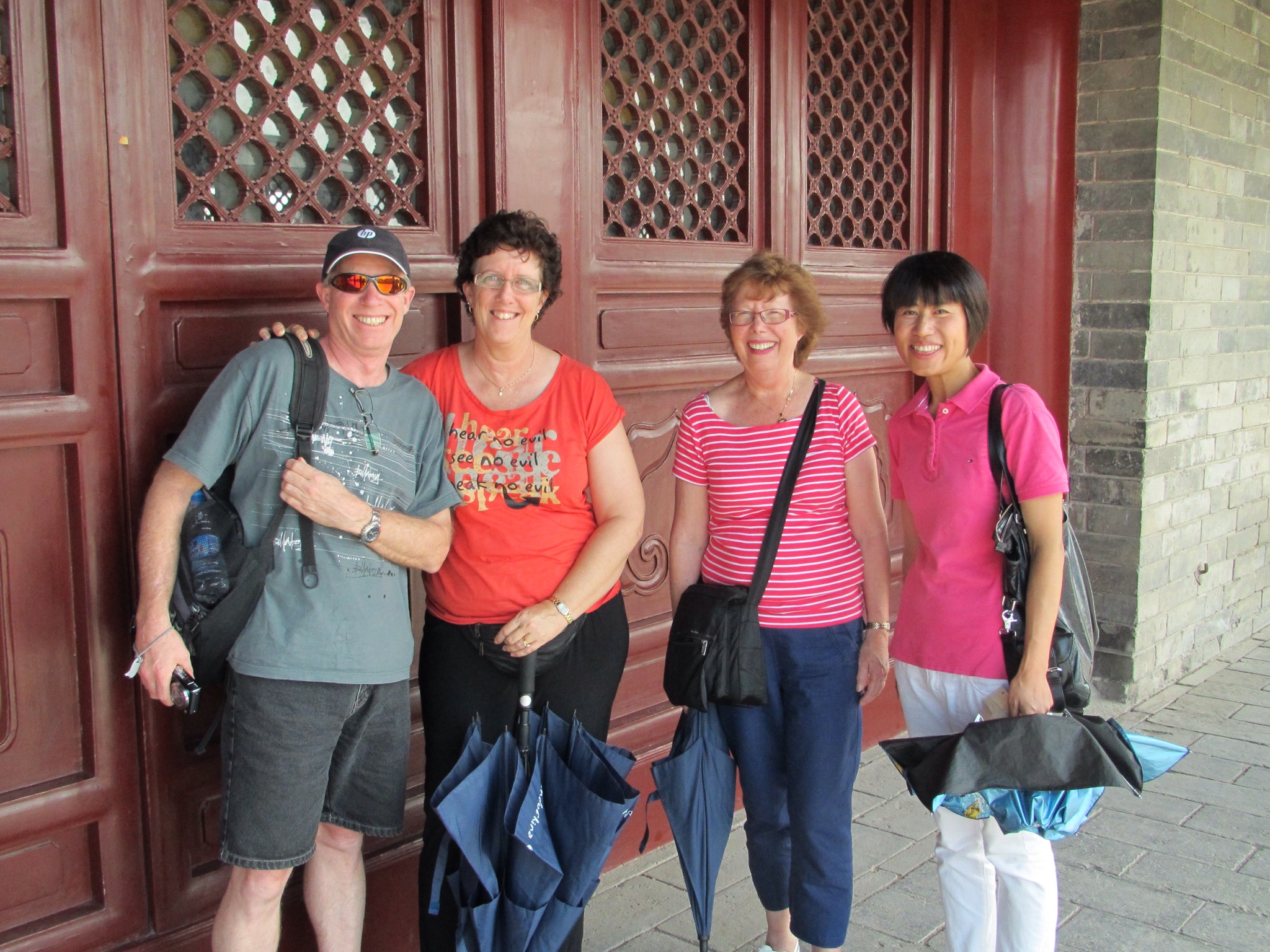
Bill and Wendy, Isabel and Helen our ( rare Jade) quality guide above the eastern gate of the original walled city of Xi’an. Day by day the continuing sunshine and blue skies necessitates umbrellas.

Xi’an is a small city of eight million and the one time capital of China. Xi’an was the origin of the Silk Road. Silk was the prized commodity and the domestication of pack animals (Chinese Camels) enabled vast quantities to be carted over long distances.
The main traders during antiquity were the Chinese, Persians, Romans, Armenians, Indians, and Bactrians (Northern Afghanistan) and from the 5th to the 8th century the Sogdians (Uzbekistan). During the coming of age of Islam, Arab traders became prominent.
Though silk was certainly the major trade item from China, many other goods were traded, and various technologies, religions, and philosophies, as well as the bubonic plague (the “Black Death”), also travelled along the Silk Routes.
Terracotta Warriors and Horses is a collection of terracotta sculptures depicting the armies of Qin Shi Huang, the first Emperor of China who was based in Xi’an. It is a form of funerary art buried with the emperor in 210–209 BC and whose purpose was to protect the emperor in his afterlife.
The display of 2,000 figures were discovered in 1974 by local farmers near Xi’an. The figures vary in height according to their roles, with the tallest being the generals. The buried Terracotta Army held more than 8,000 soldiers, 130 chariots with 520 horses and 150 cavalry horses, the majority of which remain buried in the pits nearby Emperor Qin Shi Huang’s mausoleum.
As a warm up we visited a ceramic factory where copies of the warriors are made today along with the obligatory retail showroom which included silk embroidery which Wendy and Isabel admired.
Confucius say… if you turn Oriental around, he become disoriented.
 lauranceblog.com