Saving the Eclipse Island Lighthouse

Scan

Sometime in the spring of 1976 I had an occasion to ring the dept of transport in Canberra. The reason escapes me completely—probably to do with an aircraft fly over—at least something to do with approval for a 150th anniversary event.

The very first person to speak with me commenced by inquiring as to whether I was one of those peanuts in Albany attempting to get hold of the Eclipse Island lighthouse.

“No!” I replied, “But do tell me all about it”.

He informed me that the Maritime Safety Authority vessel the Cape Don was presently at Eclipse Island, just south of the heads of King George Sound.

The ship’s engineers were on the island removing the 50 year old Chance Brothers kerosene lantern with its enormously brilliant prism lenses and taking it to the Fremantle Maritime Museum

And, Canberra was gifting to a Fremantle museum a lighthouse that had spent all it working life in Albany’s waters?

The town’s maritime history was going to float off to the Swan River colony’s port facility, in time for Perth’s 150 celebrations in 1979?

“Well, count me in as one of the peanuts” I shot back, adding “and to whom do I need to speak to pursue this matter?”

The public servant informed me that the Fremantle deal had been struck a couple of years ago; there was no way Albany was going to get Canberra to budge; and I would need to speak with his boss to take it further.

He then kindly put me through to his superior who also told me the same; that the agreement with Fremantle was water-tight and I would need to speak with his boss to take it further. And similarly he saw to it that I was progressing rapidly up the chain of command.

By now I must have been speaking with a level 6 in the national capital, same story, plenty of tut-tutting along with no! no! no! But if I wanted to speak with the head of department I would need to ring back the following morning.

Late that afternoon I went looking for the blokes removing the lighthouse and chanced upon the engineers from the Cape Don, slaking their thirst in the front bar of the Royal George Hotel.

The maritime engineer John Lemon (a really good bloke) bet me his ‘lefty’ as a guarantee we would not be successful in getting the lighthouse off-loaded in Albany the next day. Like, we were really up against it, for the job would be completed by noon the following day with the vessel heading straight to Fremantle. Lemon did however give me the dimensions and weight details of the cargo in the unlikely event the vessel pulled into Albany.

Bright and early the next day I was on the phone once more to Canberra, seeking approval from a real bigshot in the Maritime Services Dept. He was a kindly man and expressed a good deal of interest in Albany’s 150th celebrations. This was a bigwig from the national capital showing a genuine regard for the great southern community.

“You know’ he said, “I actually went to high school in Albany”

My riposte was “there’s no more compelling argument that you need to send a telegram to the master of the Cape Don and instruct him to drop the lighthouse off in Albany this afternoon?”

Shortly afterwards at around 11am I did as the bigwig instructed and went to the Albany Port Authority and spoke with the master of the ship by radio to confirm that he had received the telegram and find out when he planned to dock.

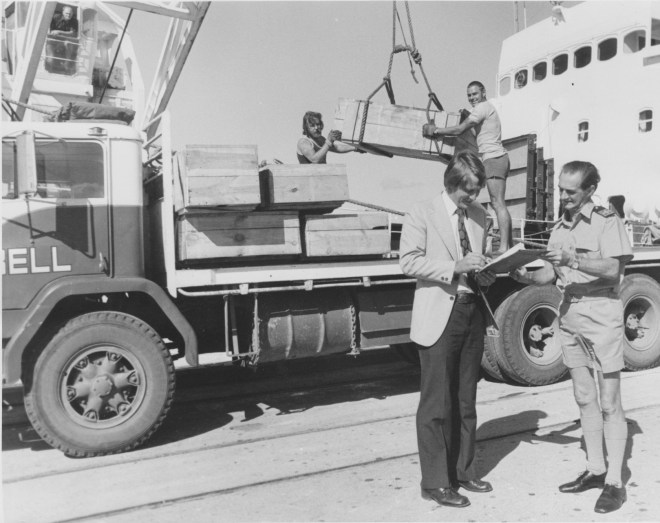
My staunchest ally mayor Harold Smith was away at the time and I need approval to get 2 semi-trailer trucks from Bell Bros down to the port by 2pm. So I sought the ok from his deputy ‘Noddy’ Richards who initially balked at any expenditure without council approval, but concluded by saying “thanks for nothing—-see you in gaol—-you better get the trucks!”

Mid that afternoon the master of the Cape Don off loaded many tons of valuable Eclipse Island lighthouse equipment, packed in boxes and had me sign a receipt on his manifesto.

Payment involved a couple cartons of beer stubbies for the crew and engineer John Lemon and in gentlemanly manner I forgave him the bet involving any anatomical parts.

Footnote:

Saving the Eclipse Island Lighthouse took less than 24 hours and the luck of coming across a former Albany student to snare this prized possession. Sadly those crates offloaded that day languished at the back of the town council depot for a decade or more before it was finally re-erected to pride of place in the Residency Museum.
 

Alice Cooper in Albany

Scan 1

Looking back to events in your life from 40 years ago you quickly discover that most of the stars and folk from your past are either now irrelevant in the present world—or dead!

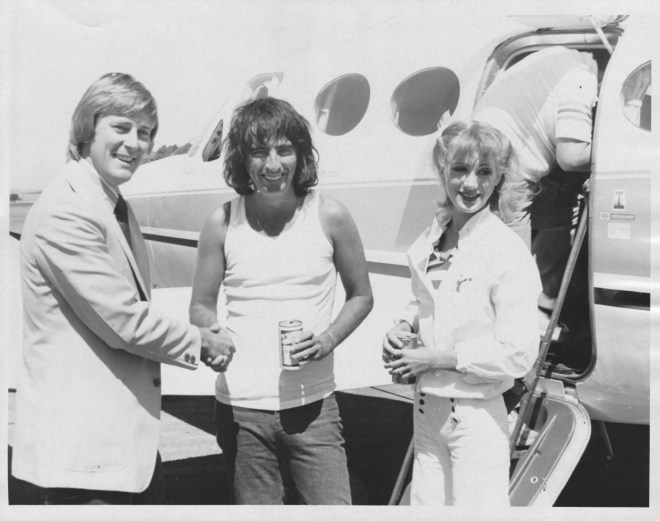
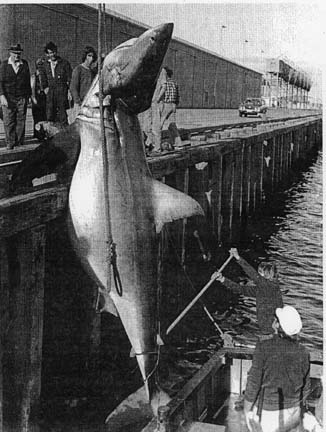
But there is one enduring name, perpetual rocker Alice Cooper who, with his wife Sheryl, visited Albany in the months prior to the Albany 150th Anniversary to try his hand at shark fishing. Prompted no-doubt, by Melbourne shark fisherman Clive Green who landed a 1550kg white pointer shark off the whaling station at Frenchman’s Bay, on Anzac Day 1976.

Sharks were a good fit with Alice Cooper’s stage antics and his minders deemed a snap or two of Cooper with sharks on a jetty at Emu Point was definitely image building.

The fact that the rock performer travelled out to sea with professional shark fishermen, who set 3km of baited hooks, was immaterial. The world’s media ran with the story and Albany benefitted from the publicity.

And today at 68 years of age you can hear Alice Cooper on radio stations around the world and he continues touring with his band.

Big game fisherman Clive Green

Early in 1976 big game fisherman Clive Green came to Albany to bag himself a white pointer shark of world record proportions. Whaling at Cheyne Beach on Frenchman’s Bay was, back then, attracting tourists who took in the early morning sights and smells of flensing the daily catch of humpbacks and sperm whales.
In addition to tourists, the whaling industry attracted many white pointer sharks that gorged themselves on a free feed of blubber. For the day’s catch of the monsters of the sea would be lightly bobbing at anchor ready for the flensers.

On a sunny mid-morning I joined Green and his party and ventured out into Frenchman’s Bay on a planked timber boat—-belonging to a helpful local fisherman—to suss out the area and plan a strategy for a record shark haul. On our approach to the whaling station we noticed a monster shark gently break the surface of the water and effortlessly ‘mouthing’ a floating 44 gallon oil drum.

What luck!

What a sight!

But another hour went by without any further sightings. Most of our number eagerly scanned the water on the starboard side of the vessel and tiring of the search, I sat on the port side being about half a metre from the water on the freeboard.

All of sudden a huge grey platform glided silently beside the boat, just below my backside. The sight took my breath away, unable to shout to the others, but the natural reflex to touch the beast overtook me and the feel of the shark’s sandpaper-like skin is still memorable today.

There were several more sightings that morning, exciting the adventurer Green to get his game fishing chair out of storage and bolted—preferably onto a steel hulled boat and mount a real challenge the following morning.

And so at dawn on Anzac Day, Clive Green accompanied by a couple of deckhands, onlookers and a Channel 7 (Perth) film crew set off from Emu Point to do battle with the feared predator.

As the day’s catch of whales was grouped together, anchored near the beach, a few sharks demonstrated for the film crew how to feed off a floating whale.
Big jaws chomp down on a sizeable chunk of blubber as they manoeuvre their bodies from side-to-side setting up a slicing motion for their razor sharp rows of teeth.

Attempting a world record shark catch on a 130lb breaking strain fishing line needs patience, stamina and most of all away from the attraction of whale blubber. For your catch must use animal bait, not marine mammal. (IGFA International Game Fishing Association rules.)

But patience was in short supply that morning and for Green the lure of hooking a big, big fish, right there in the water, was far too tempting and so a ‘first try’ using whale meat was just too overwhelming.

Slapping the water with brilliant red whale meat soon enticed the big monster to get hooked and a four hour and forty five minute battle ensued. Playing a tonne and a half of shark using a minimal 130lb line is a sight to behold. Strapped into what looks like a barber’s chair the game fisherman must keep the pressure up to the fish. And working in concert with the skipper of the boat; must know when to reverse the vessel to chase after the fish and when to power forward.

A team effort!

image

The female white pointer was 4.826metres long, over 3 metres in girth and weighed 1550kg. It was weighed at the weighbridge at Albany Port. Green is in the white cap watching on.

Albany’s 150th Amity Day

image

The afternoon was bright and sunny on that late December day in 1976 with the crowds lining York St dutifully observing the blue honour line and eagerly waiting the start of the parade.

Suddenly, the bands struck up, the bold sound of a fifty strong brass band, pipers and the Albany Silver band; Amity Day had finally arrived and 3,000 Albany residents—Mums, Dads and the their children—all dressed in period costumes of 1826—proudly swung out of the park near the library and promenaded down Albany’s main street to the applause and adulation of a 15,000 strong audience.

This surely was the town’s heartiest show of community spirit; born, not as a result of adversity, but of a passionate willingness to actually participate in a showcasing of their proud heritage and warm friendly society.

Leading the parade was WA Premier Sir Charles Court and Lady Rita Court with Albany Mayor Harold Smith and his hard working wife Doris. Sir Charles added to the sense of occasion with a silver topped swagger stick while the very tall Harold Smith’s ‘stove pipe’ top hat greatly added to his stature.

One couldn’t help but notice the official party at the lead seemed to be ducking and weaving, side-to-side as if dancing down the street. At the end of the festivities Sir Charles proffered his advice that the horses and sulkies should be at the rear—for our honoured guests had to pick their way through masses of horse poo from startled just-fed ponies.

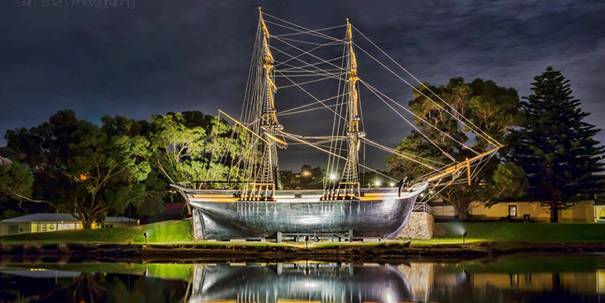
The procession turned right at the bottom of York St and headed for the Princess Royal waterfront and the Brig Amity replica. A labour of love in itself by local boat builder Stan Austin and a team of carpenters hewing keel timbers mostly using traditional hand tools.

Despite my best efforts at getting the town’s head gardener to fertilise the lawns in early spring it was he who approached me on the morning of our big opening, offering to spray the sad looking grass with a green dye. He had been out since first light spraying every bit of grass all over town. Quietly I asked him if the dye was same colour as the many spots that lined his chubby face. Peter nodded in the affirmative so I told him 3,000 people who had spent the best part of a year making their individual period costumes would not appreciate plonking their apparel on newly sprayed green dye.

With the arrival of the procession—followed by the audience—the grass at the Amity precinct was covered anyway by about 8,000 derrieres and a further 10,000 standing behind and spilling onto the harbour roadway.

There were the usual speeches and responses, always attendant at these events, leading up to the launching of the Amity itself, in the usual manner. Sir Charles was to swing the bottle of champagne at the bow (and to ensure a quick christening we had deep etched the champagne bottle with a glass cutter—so deep we even thought it may simply break in Sir Charles hand)

But no!

After 3 embarrassingly unsuccessful swings to crack the bottle, Sir Charles tore off the string, grasped it firmly and hurled it at the ship and the job was finally done, to the mirth of the gathering who thought it a great show!

A series of colourful displays rounded out the balance of the afternoon as folk drifted homeward knowing that there was a full evening programme to follow.

Putting the night-time sound and light show took lotsa planning, principally by the Perth Playhouse producer/directors Tony Youlden and John Toussaint. Local ABC newsman and author Les Johnson wrote a great script surrounding the arrival of Major Edmund Lockyer and perennial Perth actor Edgar Medcalf added his voice to the soundtrack.

Water about the Amity was tidal and fed from concrete pipes under the road linking it with the harbour. At Youlden’s insistence, of countering the limitation of relying on tidal movements for the performance, we hired a giant water pump from Perth and for two weeks blocked off the tidal access and pumped harbour water so that the level of the lake appeared to make the Amity ‘float’.

Council workers even volunteered to spend days wading through the lake and removing all the unsightly algae. Four massive scaffolded lighting towers with over 400 lights ringed the lake and all that was complemented with banks of audio speakers that would fill the harbour itself with sound.

The foreshore location of the Amity and the adjoining Residency Museum can frequently be subject to strong winds, but on the night of the son et lumiere presentation the perfect calm was like manna from heaven.

image

As darkness fell the crowds returned—again seated on the lawn—with only four chairs for our dignitaries, the Courts and Smiths. Dress for the evening was ‘casual’ which as everyone knows for Sir Charles—meant a jacket over a starched shirt and tie. The mayor arrived at the assembly point under the verandah of the museum with a daggy green t-shirt under his jacket. I pointed out to Harold that we would focus 400 spotlights upon their entry to the event and hastily removed my white dress shirt I had been wearing all day and we did a swap.

The Naval Reserve Cadets played a sizeable role in the show and at the last minute I spotted Lt Cdr Geoff Curran in his brilliant white formal naval dress uniform and so I asked him to accompany the official party to their seats. With a military style fanfare and hundreds of spotlights focussed on them our big kahunas marched to their seats and the show began.

I have always been a fan of sound and light shows and the Albany event was simply the best. There were the usual dramas to contend with; the boatswain in charge of the naval cadets rowing their historical boat past the Amity had had a celebratory drink or two and instructed up-oars too many times, which meant the tape of the show needed to be stopped, while stage crew on the lakes edge told him in loud whispers to get on with it.

Rail enthusiasts in charge of the participating steam train were not answering the telephone on the station platform and radio communication with the fireworks fellow was down. In a move designed to keep me occupied Youlden told me to relay messages about their individual cues directly to the train folk and cracker man. In total darkness I picked my way along the railway line to the station arriving to hear the phone ringing off the platform wall and the train crew shovelling coal, unable to hear it; off then to the harbour shoreline to speak with pyrotechnic expert Fred Cardile instructing him to watch for his cue when the show went to black. As I was about to walk away Fred turned to me and asked “don’t suppose you have a box of matches with you?”

I got back to the show to see the end of the rowing marathon, the colour and magic of folk dancing at the front of the residency, the giant steam train with whistle at full tilt framing the museum building and then the show suddenly went to black.

And Fred Cardile had found a box of matches.

The day had been a once in fifty year’s event.

The people of Albany had enthusiastically embraced the celebrations as their own.

But the last word must go to Sir Charles Court who in a letter written three days later……..”You should look back on the 26th of December as a great day in the life of Albany and its region”

Footnote:
Major Edmund Lockyer on the brig Amity actually arrived in King Georges Sound on Christmas Day 1826 and proceeded to have Xmas dinner on board and going ashore on Boxing Day, knowing full well future celebratory events would have been at risk if he alighted on December 25th. His great grandson Nicholas Lockyer, with his wife, came from their home in Brisbane to attend the celebrations.