Big game fisherman Clive Green

Early in 1976 big game fisherman Clive Green came to Albany to bag himself a white pointer shark of world record proportions. Whaling at Cheyne Beach on Frenchman’s Bay was, back then, attracting tourists who took in the early morning sights and smells of flensing the daily catch of humpbacks and sperm whales.
In addition to tourists, the whaling industry attracted many white pointer sharks that gorged themselves on a free feed of blubber. For the day’s catch of the monsters of the sea would be lightly bobbing at anchor ready for the flensers.

On a sunny mid-morning I joined Green and his party and ventured out into Frenchman’s Bay on a planked timber boat—-belonging to a helpful local fisherman—to suss out the area and plan a strategy for a record shark haul. On our approach to the whaling station we noticed a monster shark gently break the surface of the water and effortlessly ‘mouthing’ a floating 44 gallon oil drum.

What luck!

What a sight!

But another hour went by without any further sightings. Most of our number eagerly scanned the water on the starboard side of the vessel and tiring of the search, I sat on the port side being about half a metre from the water on the freeboard.

All of sudden a huge grey platform glided silently beside the boat, just below my backside. The sight took my breath away, unable to shout to the others, but the natural reflex to touch the beast overtook me and the feel of the shark’s sandpaper-like skin is still memorable today.

There were several more sightings that morning, exciting the adventurer Green to get his game fishing chair out of storage and bolted—preferably onto a steel hulled boat and mount a real challenge the following morning.

And so at dawn on Anzac Day, Clive Green accompanied by a couple of deckhands, onlookers and a Channel 7 (Perth) film crew set off from Emu Point to do battle with the feared predator.

As the day’s catch of whales was grouped together, anchored near the beach, a few sharks demonstrated for the film crew how to feed off a floating whale.
Big jaws chomp down on a sizeable chunk of blubber as they manoeuvre their bodies from side-to-side setting up a slicing motion for their razor sharp rows of teeth.

Attempting a world record shark catch on a 130lb breaking strain fishing line needs patience, stamina and most of all away from the attraction of whale blubber. For your catch must use animal bait, not marine mammal. (IGFA International Game Fishing Association rules.)

But patience was in short supply that morning and for Green the lure of hooking a big, big fish, right there in the water, was far too tempting and so a ‘first try’ using whale meat was just too overwhelming.

Slapping the water with brilliant red whale meat soon enticed the big monster to get hooked and a four hour and forty five minute battle ensued. Playing a tonne and a half of shark using a minimal 130lb line is a sight to behold. Strapped into what looks like a barber’s chair the game fisherman must keep the pressure up to the fish. And working in concert with the skipper of the boat; must know when to reverse the vessel to chase after the fish and when to power forward.

A team effort!

image

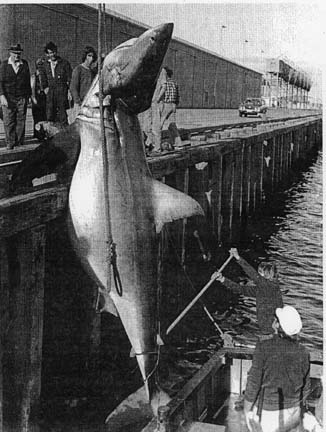
The female white pointer was 4.826metres long, over 3 metres in girth and weighed 1550kg. It was weighed at the weighbridge at Albany Port. Green is in the white cap watching on.

Albany’s 150th Amity Day

image

The afternoon was bright and sunny on that late December day in 1976 with the crowds lining York St dutifully observing the blue honour line and eagerly waiting the start of the parade.

Suddenly, the bands struck up, the bold sound of a fifty strong brass band, pipers and the Albany Silver band; Amity Day had finally arrived and 3,000 Albany residents—Mums, Dads and the their children—all dressed in period costumes of 1826—proudly swung out of the park near the library and promenaded down Albany’s main street to the applause and adulation of a 15,000 strong audience.

This surely was the town’s heartiest show of community spirit; born, not as a result of adversity, but of a passionate willingness to actually participate in a showcasing of their proud heritage and warm friendly society.

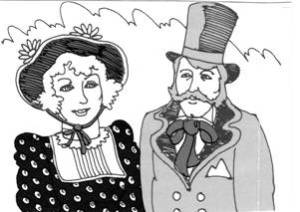
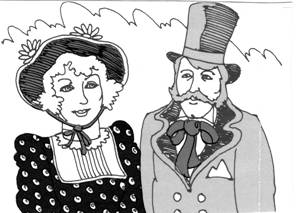
Leading the parade was WA Premier Sir Charles Court and Lady Rita Court with Albany Mayor Harold Smith and his hard working wife Doris. Sir Charles added to the sense of occasion with a silver topped swagger stick while the very tall Harold Smith’s ‘stove pipe’ top hat greatly added to his stature.

One couldn’t help but notice the official party at the lead seemed to be ducking and weaving, side-to-side as if dancing down the street. At the end of the festivities Sir Charles proffered his advice that the horses and sulkies should be at the rear—for our honoured guests had to pick their way through masses of horse poo from startled just-fed ponies.

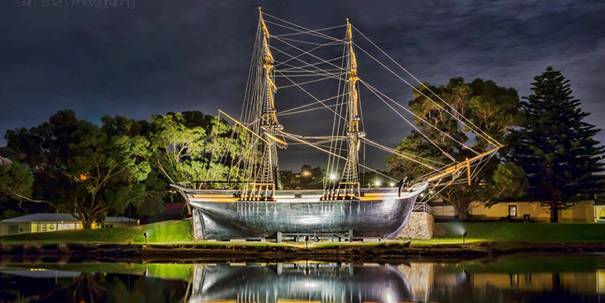
The procession turned right at the bottom of York St and headed for the Princess Royal waterfront and the Brig Amity replica. A labour of love in itself by local boat builder Stan Austin and a team of carpenters hewing keel timbers mostly using traditional hand tools.

Despite my best efforts at getting the town’s head gardener to fertilise the lawns in early spring it was he who approached me on the morning of our big opening, offering to spray the sad looking grass with a green dye. He had been out since first light spraying every bit of grass all over town. Quietly I asked him if the dye was same colour as the many spots that lined his chubby face. Peter nodded in the affirmative so I told him 3,000 people who had spent the best part of a year making their individual period costumes would not appreciate plonking their apparel on newly sprayed green dye.

With the arrival of the procession—followed by the audience—the grass at the Amity precinct was covered anyway by about 8,000 derrieres and a further 10,000 standing behind and spilling onto the harbour roadway.

There were the usual speeches and responses, always attendant at these events, leading up to the launching of the Amity itself, in the usual manner. Sir Charles was to swing the bottle of champagne at the bow (and to ensure a quick christening we had deep etched the champagne bottle with a glass cutter—so deep we even thought it may simply break in Sir Charles hand)

But no!

After 3 embarrassingly unsuccessful swings to crack the bottle, Sir Charles tore off the string, grasped it firmly and hurled it at the ship and the job was finally done, to the mirth of the gathering who thought it a great show!

A series of colourful displays rounded out the balance of the afternoon as folk drifted homeward knowing that there was a full evening programme to follow.

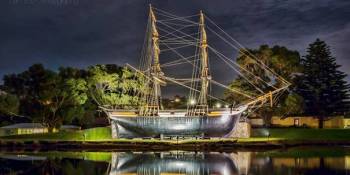
Putting the night-time sound and light show took lotsa planning, principally by the Perth Playhouse producer/directors Tony Youlden and John Toussaint. Local ABC newsman and author Les Johnson wrote a great script surrounding the arrival of Major Edmund Lockyer and perennial Perth actor Edgar Medcalf added his voice to the soundtrack.

Water about the Amity was tidal and fed from concrete pipes under the road linking it with the harbour. At Youlden’s insistence, of countering the limitation of relying on tidal movements for the performance, we hired a giant water pump from Perth and for two weeks blocked off the tidal access and pumped harbour water so that the level of the lake appeared to make the Amity ‘float’.

Council workers even volunteered to spend days wading through the lake and removing all the unsightly algae. Four massive scaffolded lighting towers with over 400 lights ringed the lake and all that was complemented with banks of audio speakers that would fill the harbour itself with sound.

The foreshore location of the Amity and the adjoining Residency Museum can frequently be subject to strong winds, but on the night of the son et lumiere presentation the perfect calm was like manna from heaven.
image

As darkness fell the crowds returned—again seated on the lawn—with only four chairs for our dignitaries, the Courts and Smiths. Dress for the evening was ‘casual’ which as everyone knows for Sir Charles—meant a jacket over a starched shirt and tie. The mayor arrived at the assembly point under the verandah of the museum with a daggy green t-shirt under his jacket. I pointed out to Harold that we would focus 400 spotlights upon their entry to the event and hastily removed my white dress shirt I had been wearing all day and we did a swap.

The Naval Reserve Cadets played a sizeable role in the show and at the last minute I spotted Lt Cdr Geoff Curran in his brilliant white formal naval dress uniform and so I asked him to accompany the official party to their seats. With a military style fanfare and hundreds of spotlights focussed on them our big kahunas marched to their seats and the show began.

I have always been a fan of sound and light shows and the Albany event was simply the best. There were the usual dramas to contend with; the boatswain in charge of the naval cadets rowing their historical boat past the Amity had had a celebratory drink or two and instructed up-oars too many times, which meant the tape of the show needed to be stopped, while stage crew on the lakes edge told him in loud whispers to get on with it.

Rail enthusiasts in charge of the participating steam train were not answering the telephone on the station platform and radio communication with the fireworks fellow was down. In a move designed to keep me occupied Youlden told me to relay messages about their individual cues directly to the train folk and cracker man. In total darkness I picked my way along the railway line to the station arriving to hear the phone ringing off the platform wall and the train crew shovelling coal, unable to hear it; off then to the harbour shoreline to speak with pyrotechnic expert Fred Cardile instructing him to watch for his cue when the show went to black. As I was about to walk away Fred turned to me and asked “don’t suppose you have a box of matches with you?”

I got back to the show to see the end of the rowing marathon, the colour and magic of folk dancing at the front of the residency, the giant steam train with whistle at full tilt framing the museum building and then the show suddenly went to black.

And Fred Cardile had found a box of matches.

The day had been a once in fifty year’s event.

The people of Albany had enthusiastically embraced the celebrations as their own.

But the last word must go to Sir Charles Court who in a letter written three days later……..”You should look back on the 26th of December as a great day in the life of Albany and its region”

Footnote:
Major Edmund Lockyer on the brig Amity actually arrived in King Georges Sound on Christmas Day 1826 and proceeded to have Xmas dinner on board and going ashore on Boxing Day, knowing full well future celebratory events would have been at risk if he alighted on December 25th. His great grandson Nicholas Lockyer, with his wife, came from their home in Brisbane to attend the celebrations.
Just for the record

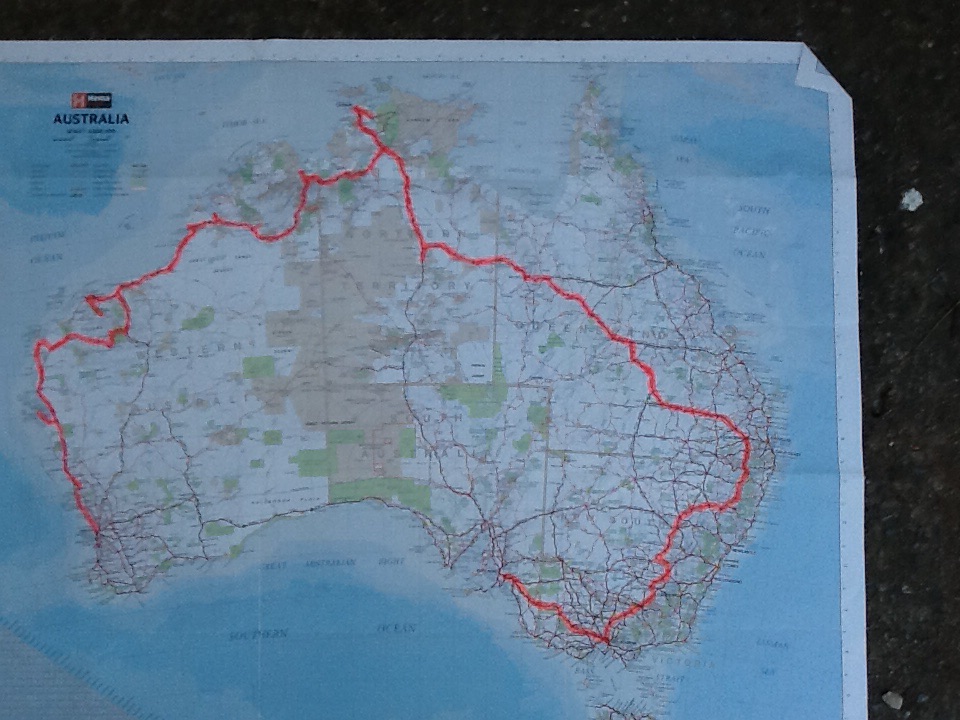
We chose to overnight at Kellerberrin about 50km closer to our home destination tomorrow. This drive-through site in the wheat belt township is actually our 50th caravan park we have stayed in since leaving home nearly 5 months ago.
This time tomorrow we will have covered 19,400 kilometres, bought over 3,500 litres of fuel from 89 service stations and enjoyed every minute of the trip.
We’ve seen spectacular mountain ranges, in a vast array of colours, shapes and sizes. We’ve wondered at the brilliant Australian tree stocks; from those that inspired Namatjira, to the quirky eucalypts that enchanted Heysen. Every morning we awoke to the sounds of birds; screeching pink and grey Galahs, Kookaburras and the ever present Noisy Miner birds that seemed intent on bothering all other bird varieties in their neighbourhood. Black swans, white swans, sulphur crested cockatoos, crested pigeons, shags, blue and red fairy wrens, the striking mailbox red of the King Parrots, wild brush Turkeys and a murder or two of crows—mainly limited to the Adelaide Hills.
We’ve celebrated Isabel’s birthday with a fish and chips lunch on the seafront at Denham— our 48th wedding anniversary with dinner in the balmy resort setting at Katherine in the NT and not forgetting Quinn’s second birthday in the Melbourne CBD.
Sage advice from an experienced R.A. (Round Australia) caravanner suggested we did not need an air-conditioner. We thought about that in Tenterfield NSW when the temperature inside the caravan overnight plunged to minus one degree. As soon as we reached Armidale we hunted high and low for an electric blanket and a small electric heater for dealing with more of the shivering night temperatures. But with summer approaching all the major retailers were offering fans, not heaters. Like, when we looked for a simple fan in the NT there was no supplies, as it was the winter season. Every town in the hot tropics close down and ‘winterise’ their local swimming pool for the season, even though the mercury climbs beyond 34 degrees.
Being nearly five months on the road and living out in the fresh air tends to encourage luxuriant hair growth—suffice it to say it looks a little unruly! Women’s’ hairdressing is always readily available within the caravanning community. Hairdressers are as popular as country and western singers among the neighbourhoods on wheels.
Purchased a couple of new tyres in Toowoomba, drove off downtown afterward and 2 warning lights lit up on the dashboard. The car didn’t have any ABS (brakes) nor ESC (stability control).
Took it back to the tyre place and the kid serving me tells me it is the silicon on the new tyres and it will correct itself once the shiny applicant wears off.
But a local auto electrician stuck a probe under the dashboard and replaced a brake pressure switch. Good thing I didn’t believe in silicon fairies at the bottom of the garden.
And finally after paying for fuel in the town of Tambo I asked the lass how far it is to Roma down the road. “Depends how fast you drive” she responded with a quizzical look.

The road from Kalgoorlie westward invoked memories of lotsa jiggling.

A trip down memory lane

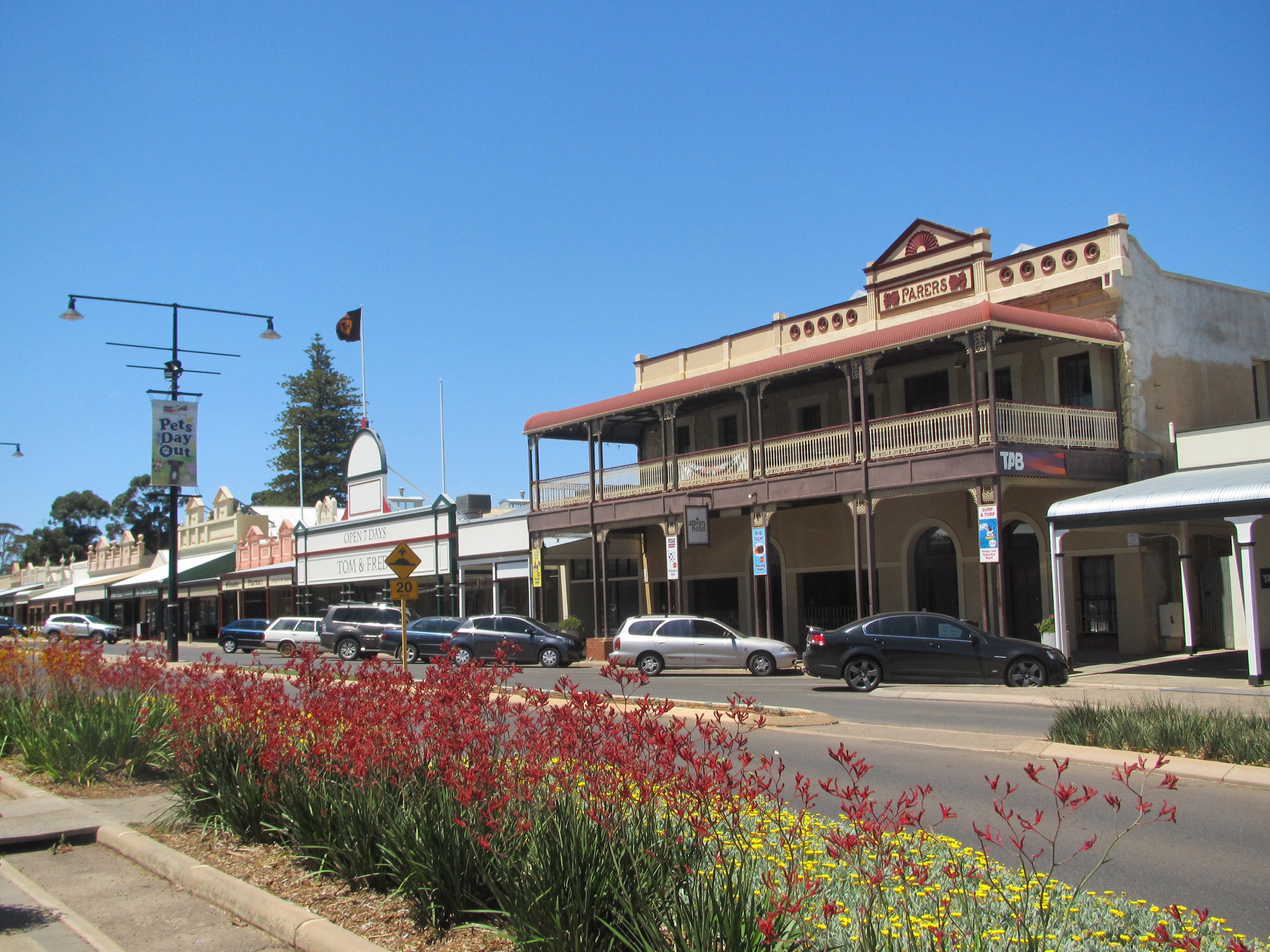
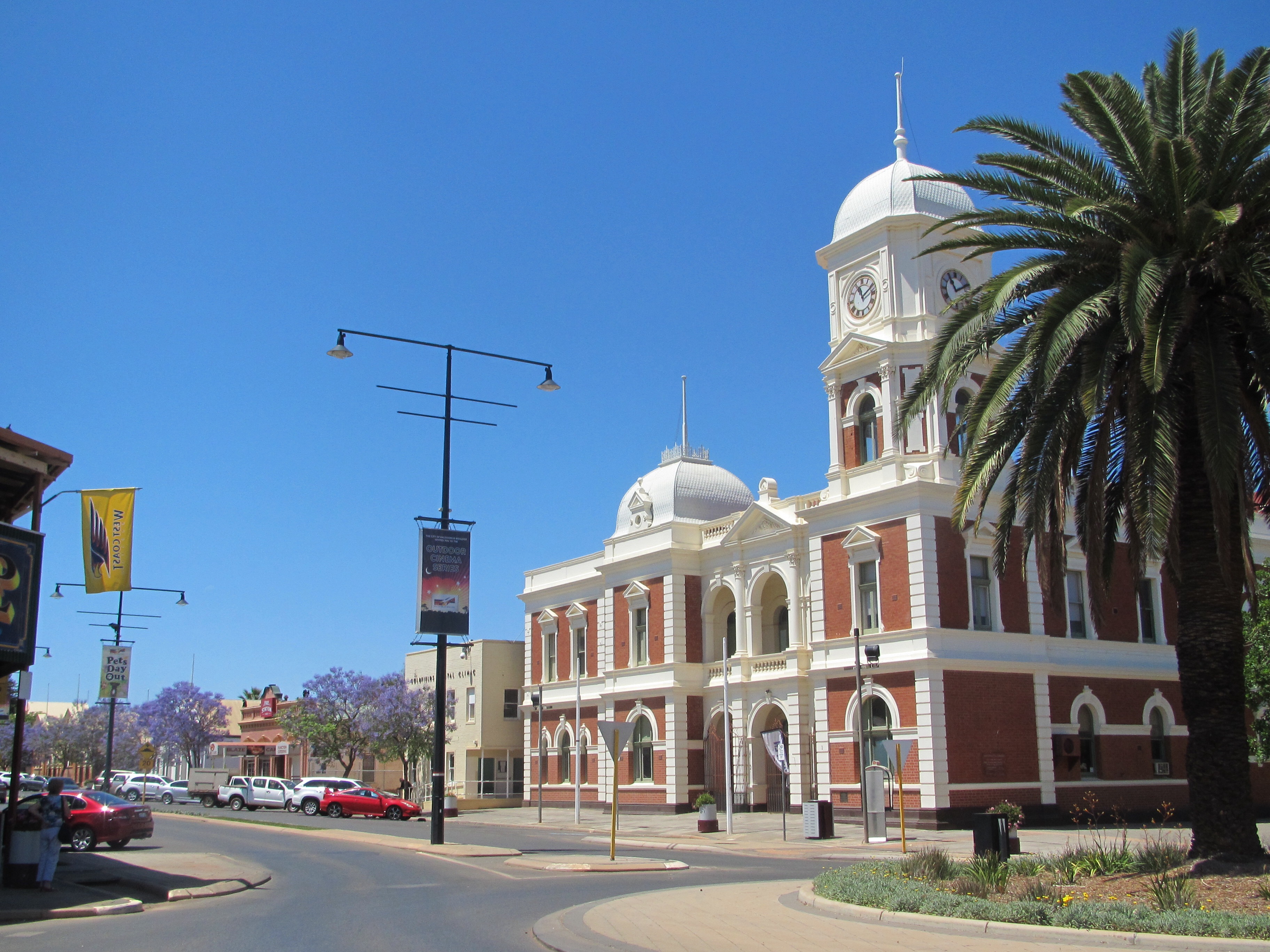
With the approach of the centenary celebrations of Kalgoorlie Boulder in 1993 it was obvious that Boulder’s main thoroughfare of Burt St needed a new party dress. Boulder was the orphan Annie of the twinned towns on the goldfields; depressingly in need of more than a face-lift, with crumbling shop fronts and verandas a testimony to decades of dwindling commerce. I mean really sadly down-at-heel.
As a part of the celebrations I canvased the Burt St shopkeepers to attend a meeting in the town hall to discuss a community project— Main Street— a facelift project which had reversed the fortunes of similar small towns the world over. So why not Burt Street Boulder?
Every week for 3 weeks I called upon all the traders in the street encouraging them to at least invest an hour and attend the 6 o’clock meeting. Once a week for three weeks I gave them a gentle reminder, (shut the shop, count the takings and come to the meeting.) by which time I knew all the shop keepers on first-name friendly terms.
And come they did! The town hall was filled with perhaps skeptical, or maybe grudging retailers and landlords alike,
But they came!
Sadly, 25 years ago the vision finally came to naught. The town needed a bomb under it!
The bomb actually struck Boulder at 8-17am on an April day in 2010 as an earthquake moved the crumbling retail hulks.
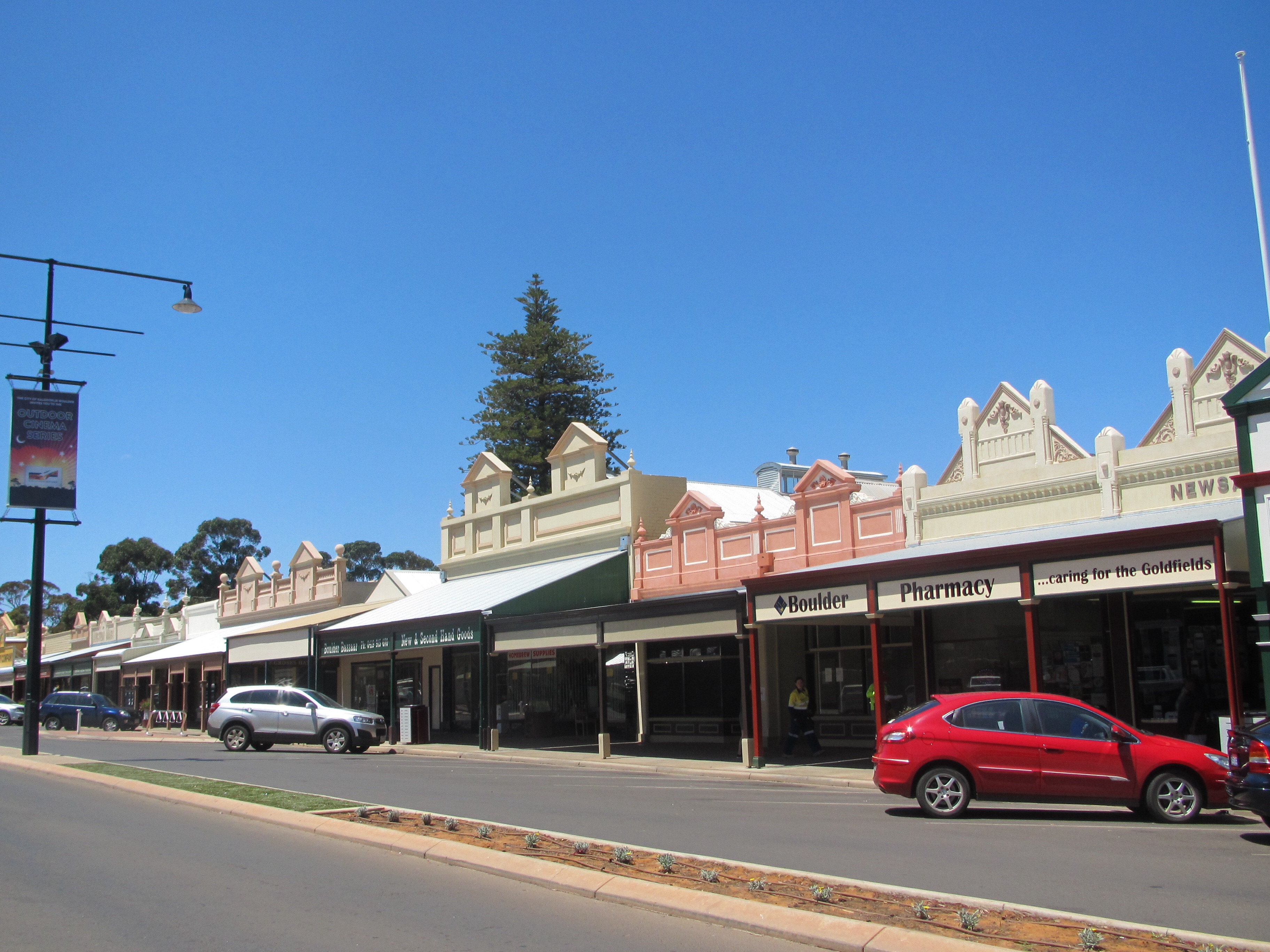
I guess between insurance claims and State Govt intervention, today, Burt Street Boulder looks a treat. New verandahs and tuck pointing which highlight replacement walls. Quite spectacular!
Sadly there appears to be little additional commerce being carried on in spite of the new shopfronts. When your commercial street fills with Tarot readers, spiritualists and specialist Halloween sellers you know you are plumbing the depths of attractive retailers.
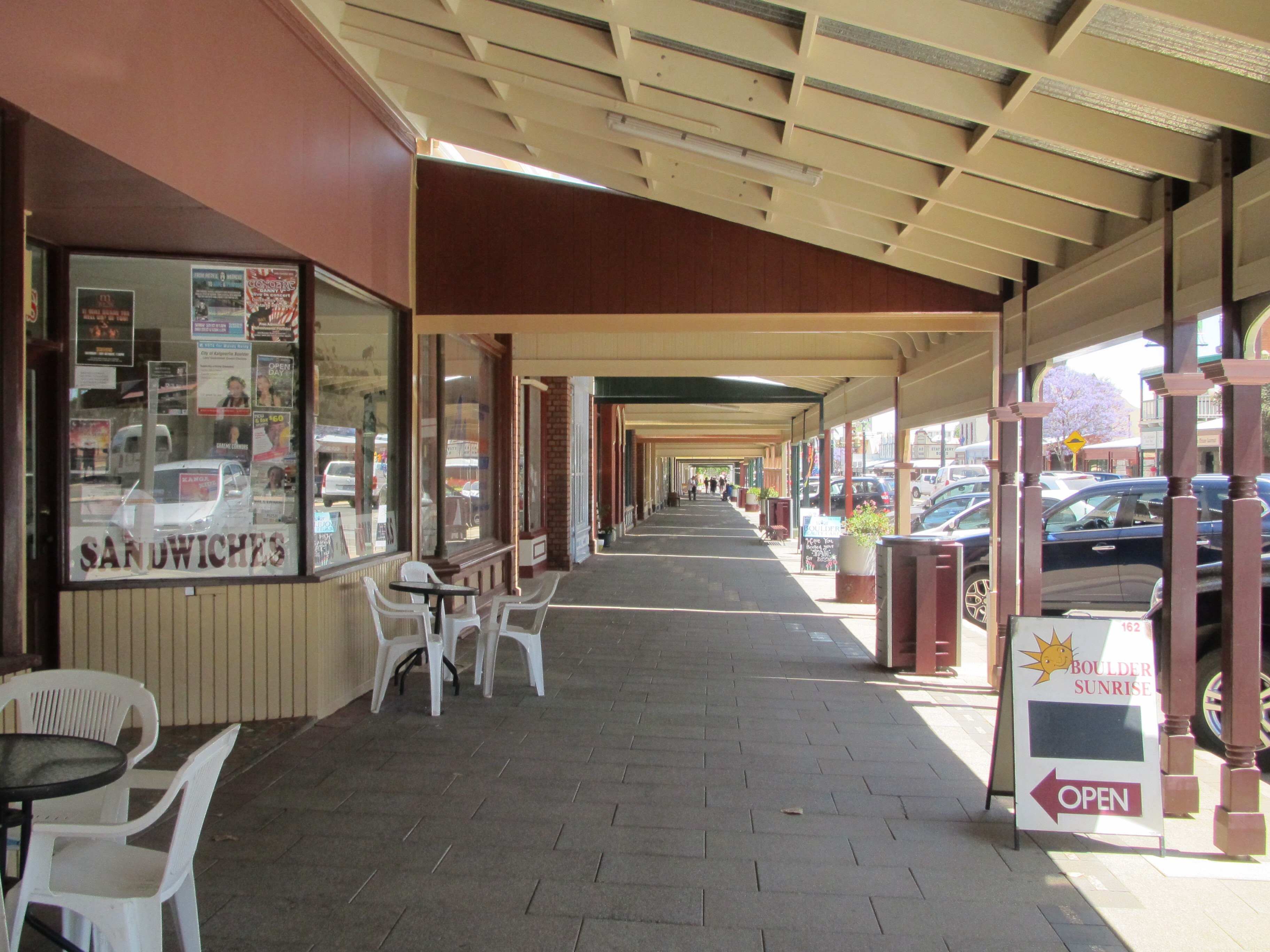
But Main Street Boulder has a brilliant new character. Wide verandah’d pavements in shade, interspersed with man-seats to enable women to shop untrammelled by grumpy old husbands eager to depart.
We’ve enjoyed another superb Indian meal tonight and tomorrow (wed) we head for Merredin before arriving home on Thursday.

The new image of wide verandah shop fronts.

imageimageimage

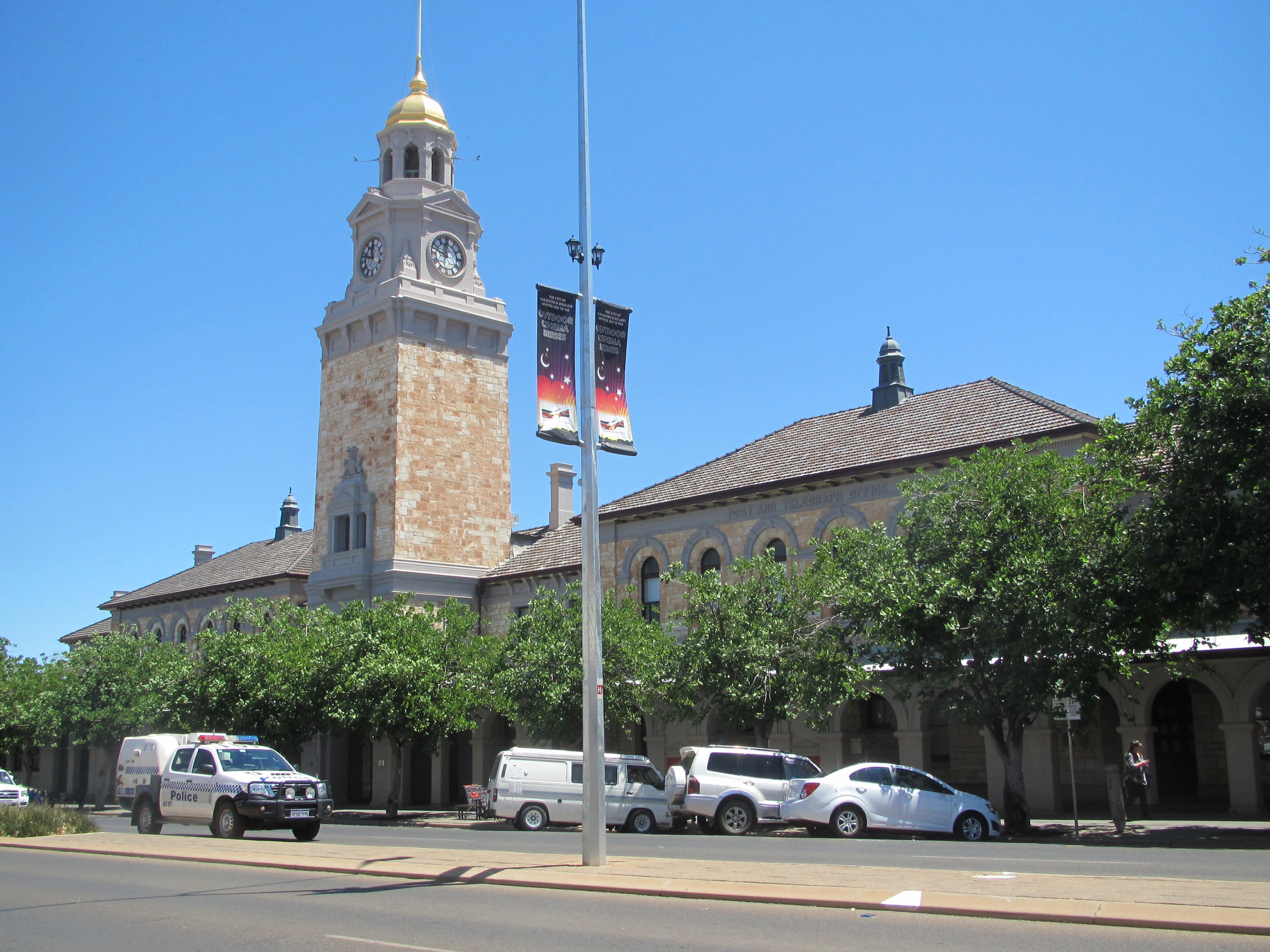
Perhaps this country's best restored Australia Post Offices in Hannan St Kalgoorlie
Perhaps this country’s best restored Australia Post Offices in Hannan St Kalgoorlie

Eucla on Saturday night

Back in 1976 I attended a channel 7 live broadcast “In Eucla Tonight” hosted by Stuart Wagstaff—a locally produced, outback one-off special event to celebrate the final sealing of the WA section of the Eyre Highway.
The South Australian section of the highway had been finished five years previously, so the SA ministerial toff welcomed Ray O’Connor, the WA road supremo, with a hand shake across the border and inquired “what kept you?”
Thirty four Albany dudes in 1826 period costumes were not about to miss a television event and the opportunity of fulfilling the director’s wont for a local audience in the bar of the Border Village.
The Albany folk knew how to take over live television specials. The Mayor of Albany introduced himself “I’m Harold Smith” with his wife “I’m Doris Smith” and next in line tourist boss Len Smith did his intro,with my secretary Lorraine Smith following. So I continued exclaiming I was Brian Smith! With that the interview lady’s jaw dropped, so I politely expounded upon the fact of in-breeding in the great southern township.
Albany’s 150th anniversary celebrations was off to a flying start, live to air no less?,
Yesterday we stopped off at Eucla to reminisce after traveling 620km from Poochera. Few if anything has changed. The Border Village bar’s skeletal remains look similar after nearly 40 years, the pot holes are more numerous than ever at Eucla caravan park and Stuart Wagstaff actually died earlier this year.
And today with the bit firmly between my teeth we did 709km to reach Norseman in time for Sunday night tea. Sixth or 7th Nullabor crossing accomplished.
We plan spending a couple of nights in Kalgoorlie before reaching home before the weekend.

The perennially popular Stuart Wagstaff
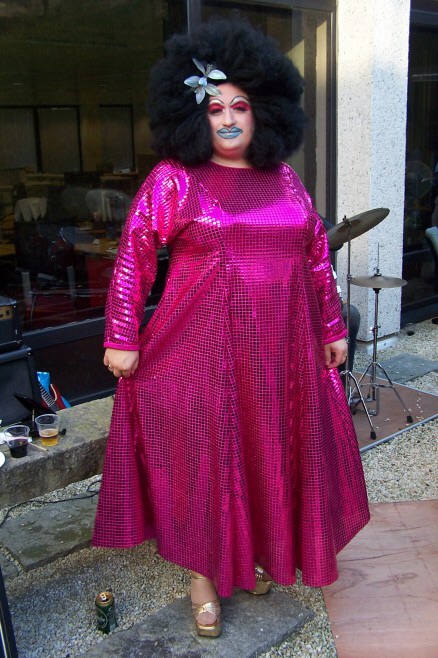
One of the featured artists on the live TV spectacular was Miss Burley Chassis

The dog’s are barking

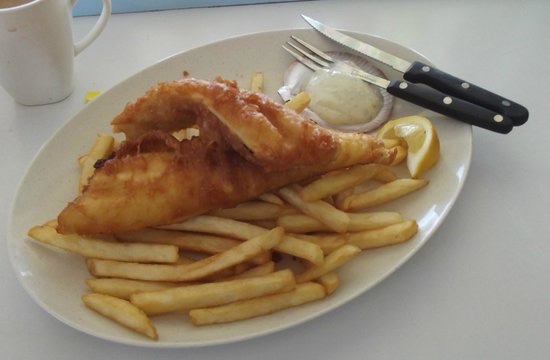
A plate of giant whiting fillets at The Port Hotel in Ceduna

This morning we tossed up whether (weather!) to leave Clare and head west, or simply leave it for a day. The appropriately titled BOM forecast winds of up to 45km an hour emanating from the south east or the north west, 10% chance of rain and possible thunderstorms. That’s like have a dollar each way!
But for me, bugger the forecast, it was all about the prospect of mouth-watering whiting fillets for dinner at the Port Hotel in Ceduna.
Undaunted we set off into a morning wind-tunnel at 45km an hour in mostly sunny conditions, driving into the real prospect of thunderstorms or perhaps an electrical storm after lunch and finally an afternoon of solid cloud-covered drizzle. (Payout the BOM on their bets!)
Sadly, as the afternoon wore wearily on, the vision of a plate of whiting fillets was fast fading with a further 140km left to accomplish an arrival in Ceduna. The navigator/co-pilot was warning that 500km a day in four seasons was testing my endurance and so grudgingly we turned into a 4star (according to Wikicamps!) caravan haven at the little-known town of Poochera.
POO–chera seemed a likely title for the place as I got out of the car for a fill at the local roadhouse; for I was soon enveloped in a plague of bushflies—- the like of which we hadn’t seen in 16,000 km around Australia so far. Obviously there was something smelly about Poo–chera to attract the title “bush fly capital of the world”
Undeterred we paid and went into the 4star Wikicamps wonder located behind the Poo–chera pub (circa 1930) marvellously hidden behind the enormous concrete grain silos on the main road.
For a one-off payment of $20 this was nirvana—as we were the only caravan in the park!
Just as the 5 o’clock happy hour commenced a second rig arrived heralding a deeper and more meaningful name to the little town site of POOCH—era!
For the neighbouring rig was in fact a canine courier—not a horse float, a genuine designated dog deployer, a pooch palace on rollers. Flea-bags, mutts, mongrel, hound, bitch, man’s best friend, fido, cur, puppy or tail-wagger; they all bark and here in Poochera they yapped in unison.
A genuine neighbourhood doggy greeting is continuing even as I put this post to bed a little after 8.30 pm.
I would rather have flirted with the ever present danger of an extra 140km on the road to whiting fillet heaven than suffering sleeping with dogs.
Now the real Wikipaedia, not wikicamps, nor the leaking Assange version has this to say about Poochera.

Poochera, however, is probably best noted for its nearby colonies of Dinosaur Ant (Nothomyrmecia macrops), a rare, primitive species of ant that has attracted entomologists and evolutionary biologists from around the world. Only one other colony near Penong, 180 km away is known to exist.
(We definitely won’t be stopping at Penong either!)

Even the local dogs can read what's carried in the canine conveyance
Even the local dogs can read what’s carried in the canine conveyance
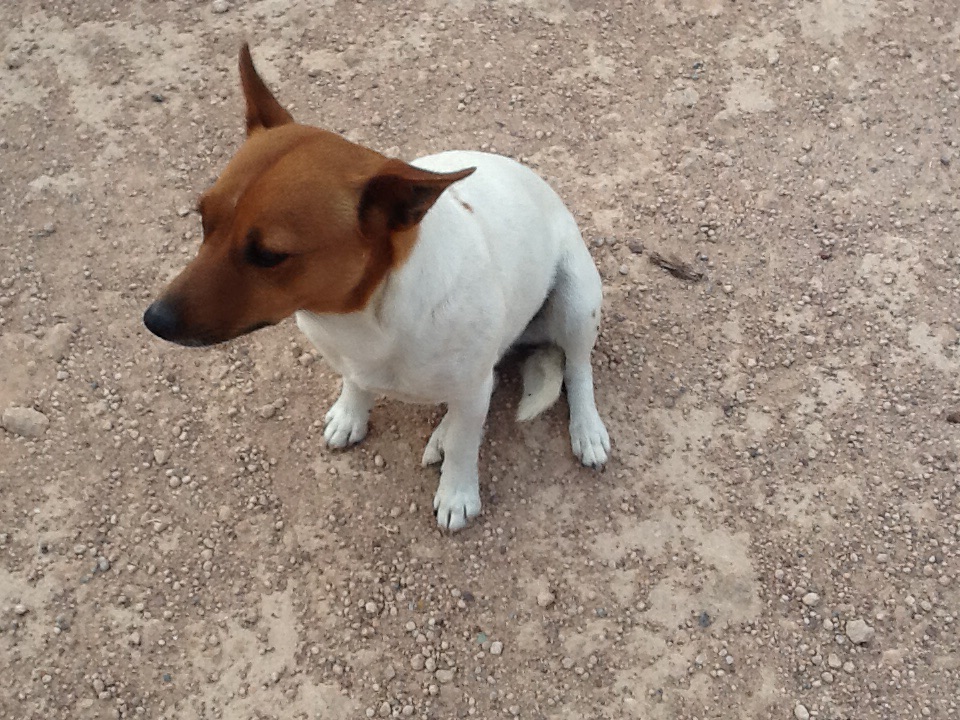
"What barking?" "Don't look at me" said this little fellow
“What barking?”
“Don’t look at me” said this little fellow
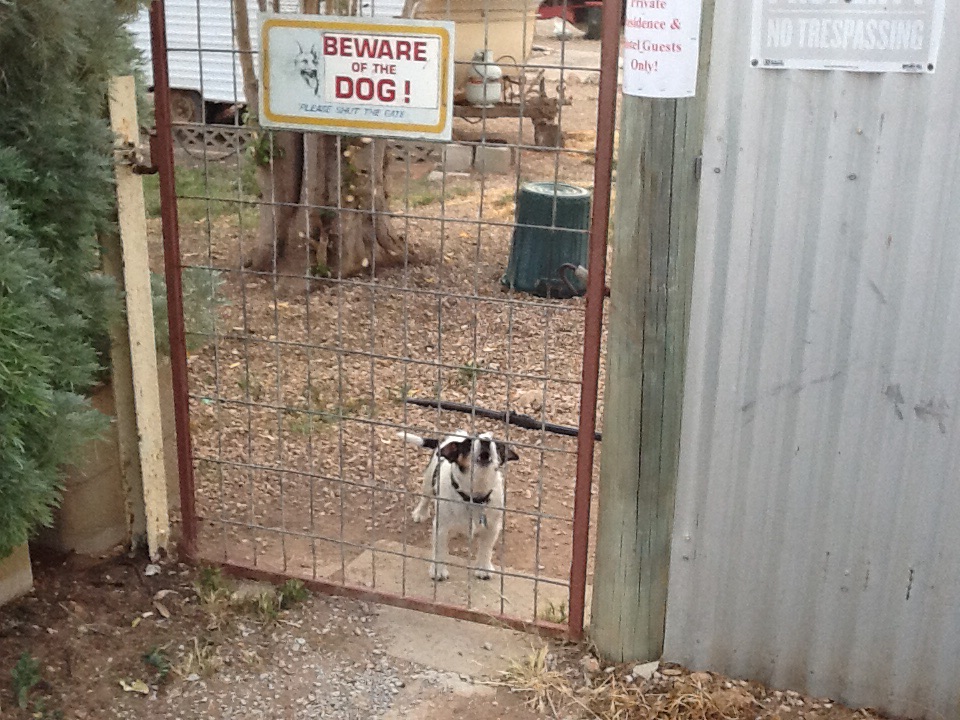
This little chap was a real threat!

Bound for South Australia

Last night we pulled into Horsham, one of our favourite Victorian towns, to find that one of Australia’s top Indian restaurants—–appropriately located in Firebrace Street—–was closed on Monday nights.
Although overnight the temperature dropped to 3 degrees, today (Tuesday) has been a beautiful day for travelling with sunny blue skies above, no wind and it took all day for the temperature to finally rise to a warming 20C.
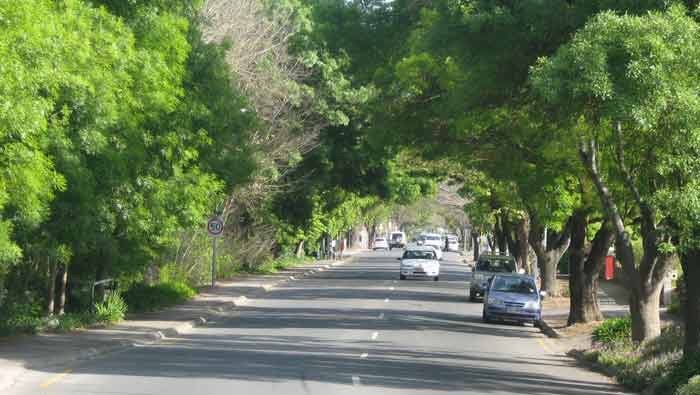
Today we covered 399kms to arrive in another of our favourite Aussie places—-Hahndorf—-in the Adelaide Hills, with an idyllic parking spot under the Camphor Laurel trees in a park in Mt Barker.
And what you may ask does the SA town have in common with the twin of the same name in WA?
A Captain Collett Barker discovered the S.A. Mt Barker Summit in 1831, but unfortunately he got killed by aborigines a couple of days later at the mouth of the Murray River. Therefore Captain Charles Sturt named the SA town after Barker. Similarly, a Scottish RN surgeon TB Wilson was exploring northward of the Albany region in WA two years earlier in 1829 with the said Captain Collett Barker and nominated the pommie soldier’s name be applied to the great southern township.
Following a few days here in the Adelaide Hills (home I might add of Alexander Downer) we plan a few more days spent in the lovely Clare further north, before heading off for delicious whiting fillets at the Port Hotel in Ceduna and the journey across the treeless plains of the Nullabor.

Our journey has progressed a lot.

image

Streetscape in Hahndorf
Another streetscape pic outside the Hahndorf pub
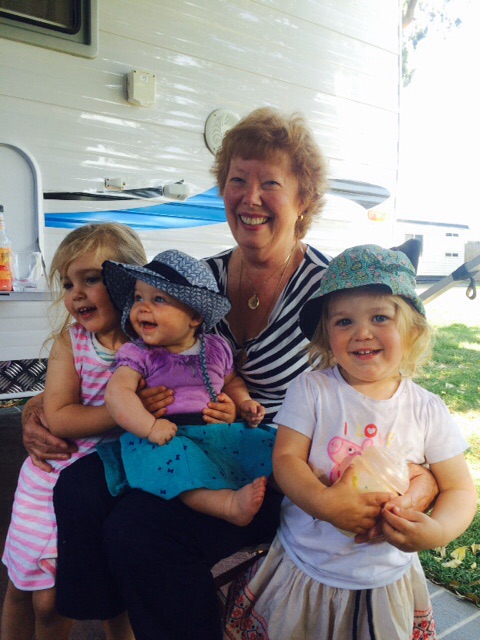
A lovely pic of Isabel with the three girls back in Melbourne

Happy Victorian Times

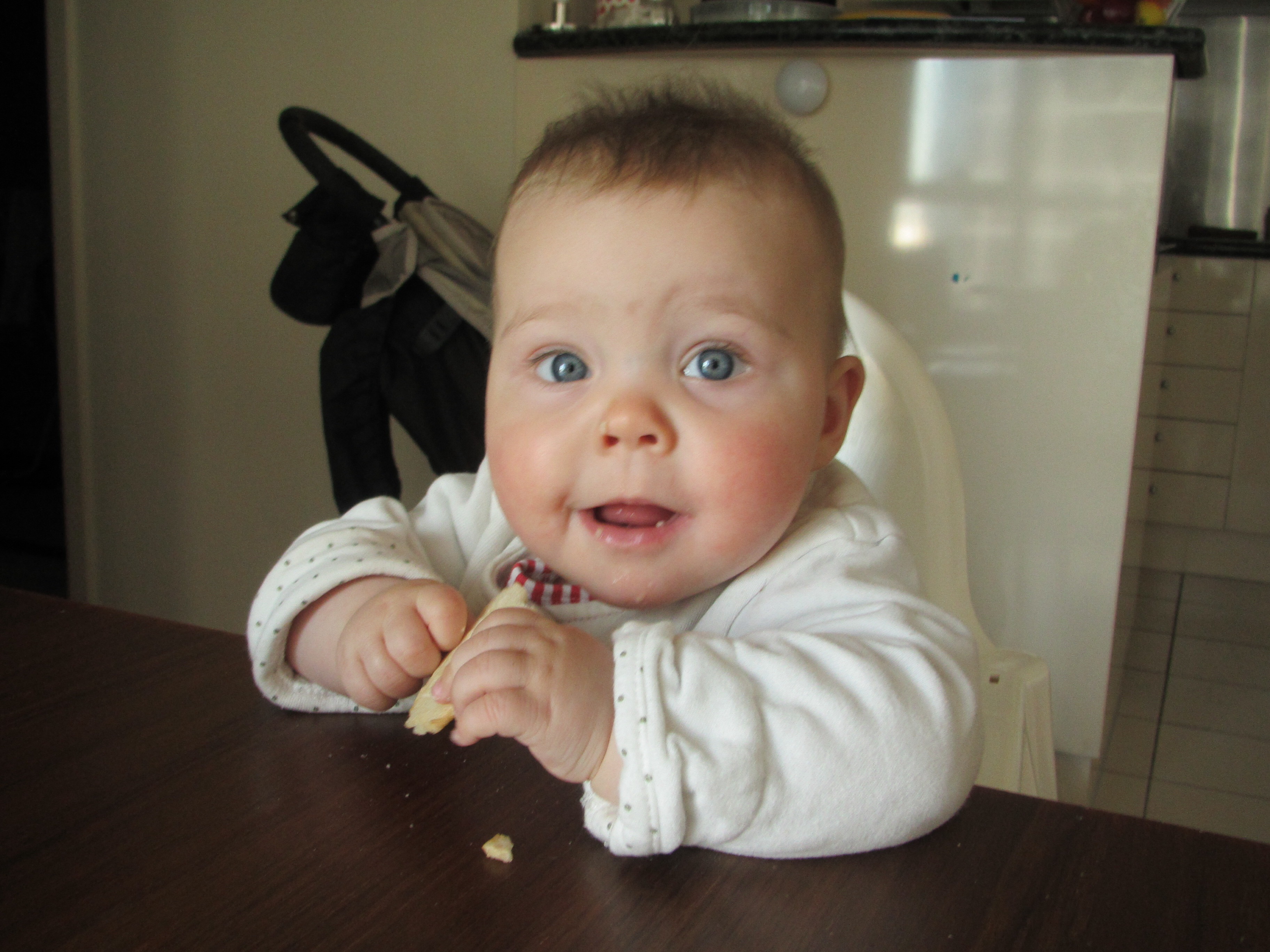
Aargh!! Roma. What a beautiful little darling.
Aaagh! Roma. What a beautiful little darling.

We have been in Melbourne for 10 days by the time we leave tomorrow (Mon 12th Oct) and heading for home via the Adelaide Hills. It’s been ten days of a terrific time in the Victorian capital with Jas and Stu and the 3 gorgeous little darlings. Lots of hugs and tiny Tim Tams, boxed drinks, Kit-Kats, tiny-tot sized bags of crisps, visits to the swings and even a little baby sitting at night.
Our caravan park is a mere 9 km from the city centre where the Melbournian branch of the family has been holed up for the past week while the chippies get on with rebuilding their 100 y.o. home in nearby Northcote.
Architect Jasmin of Ruckers Hill, Northcote has the planning sorted; in-between breast feeding and numerous nappy changes across the familial line along with meetings with plumbers, electricians and Steve the builder.
The re-build, originally thought to be completed by mid-October is probably likely to extend to Xmas; or perhaps even until Roma (now at 7 months) is out of nappies.
But it must be said the complete gutting and energetic renewal will lift this classic federation-ish home into the 21st century—-a home of giant proportions with very high ceilings, a mezzanine office-cum-library / parent retreat and family friendly features you only see on the TV series Grand Designs. (Eat your heart out Kevin McCloud!)
We’ve loved our time in Melbourne and it has whetted our appetite for home and the rest of the family out-west.

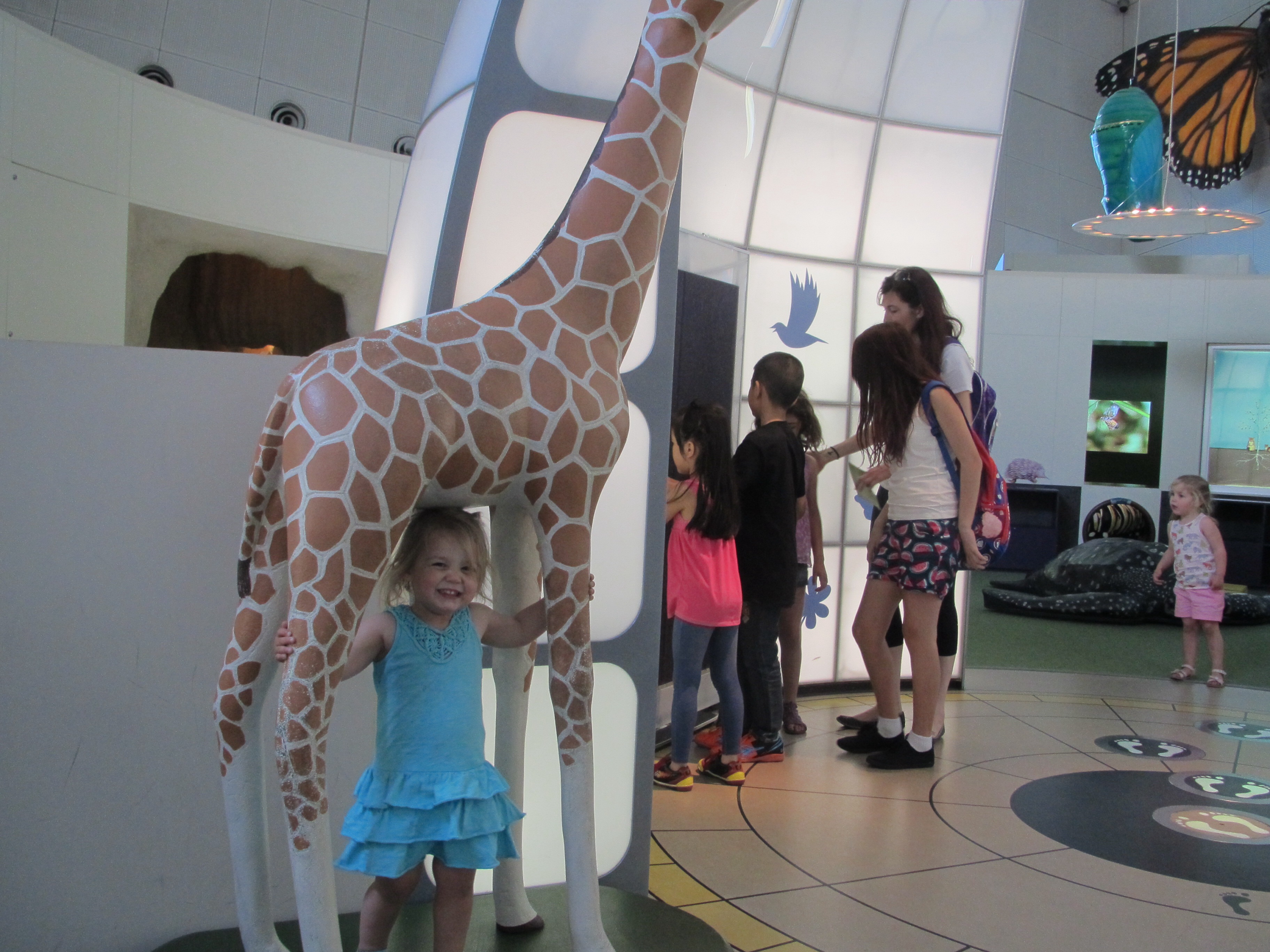
When Granma took the littlies to the Melbourne Museum Quinn thought it fun to hide under a Giraffe while big sister Frankie (far right) looked for her.
When Grandma took the littlies to the Melbourne Museum Quinn thought it fun to hide under a Giraffe while big sister Frankie (far right) looked for her.
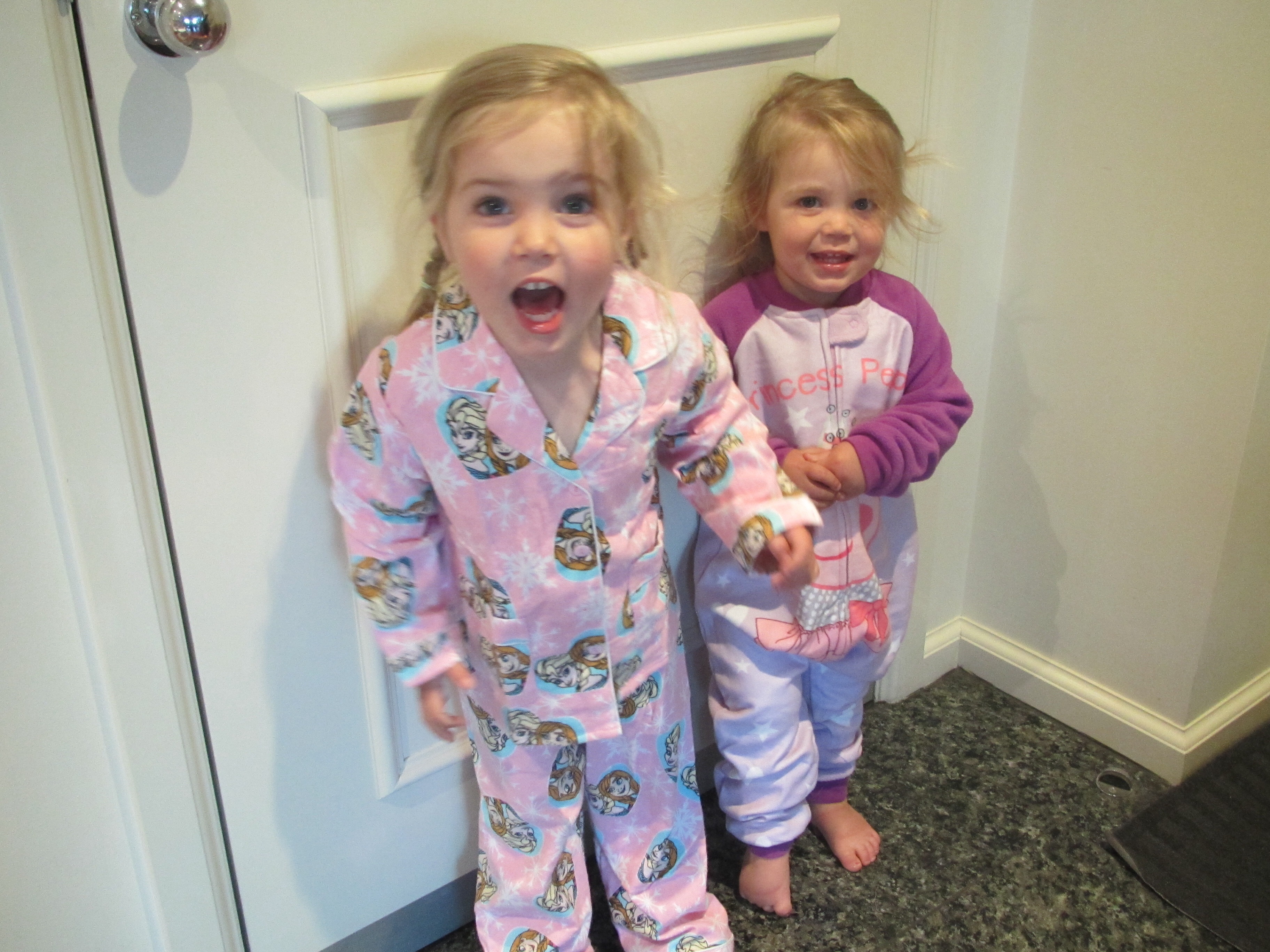
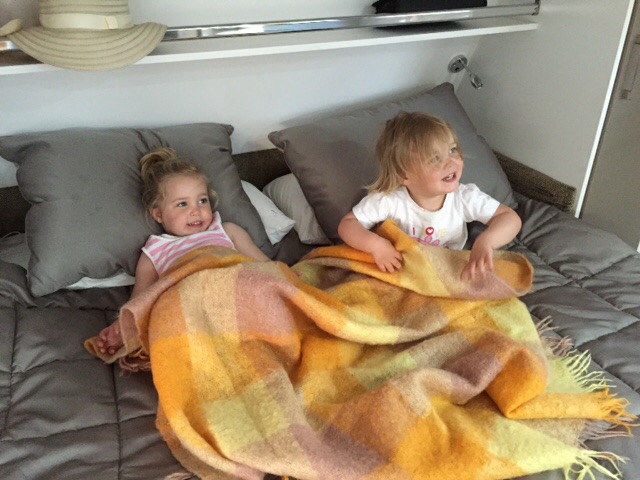
Frankie and Quinn ready for bed.
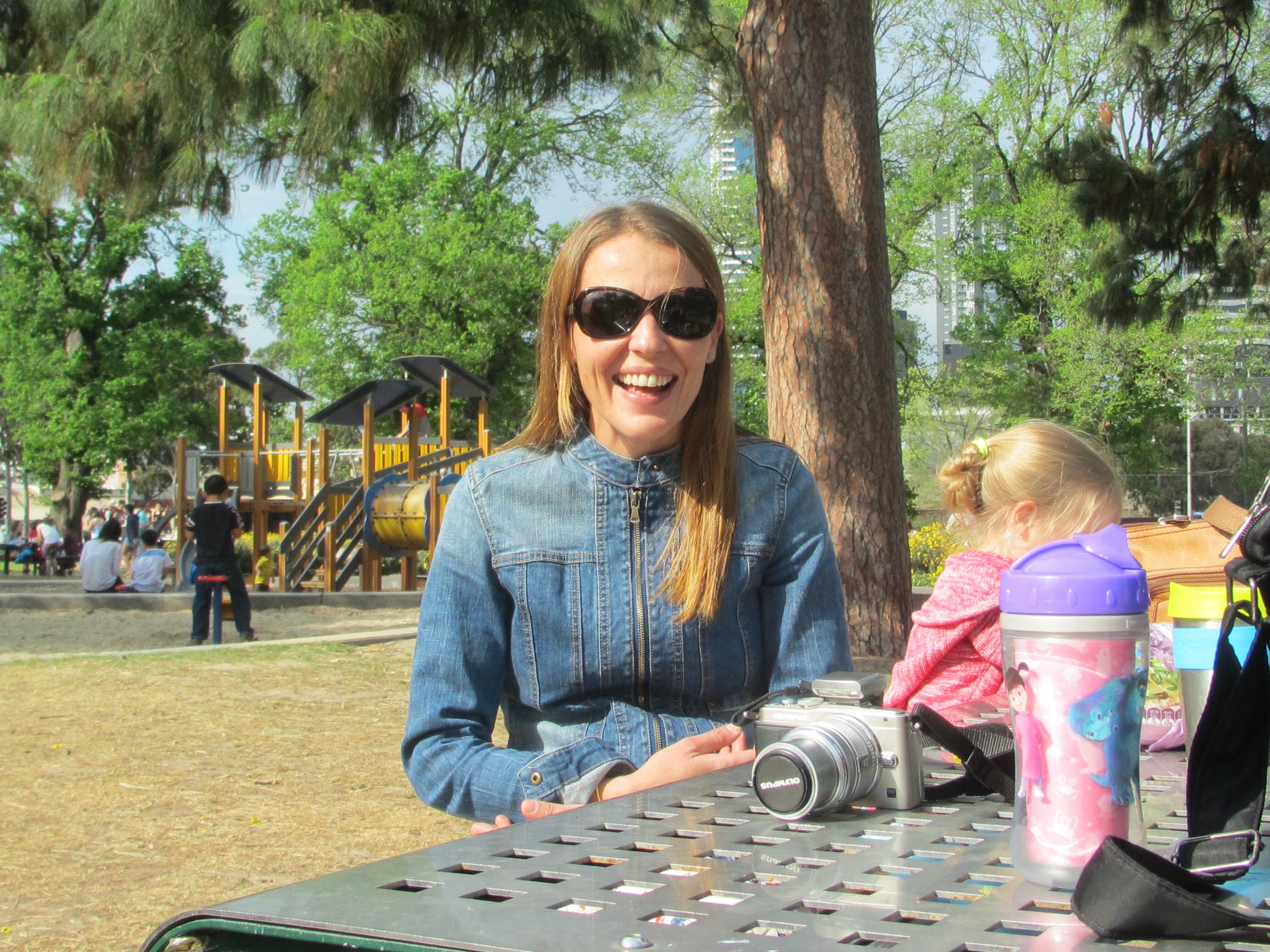
Jas and Quinn at our picnic in Flagstaff Gardens
Jas and Frankie at our picnic in Flagstaff Gardens
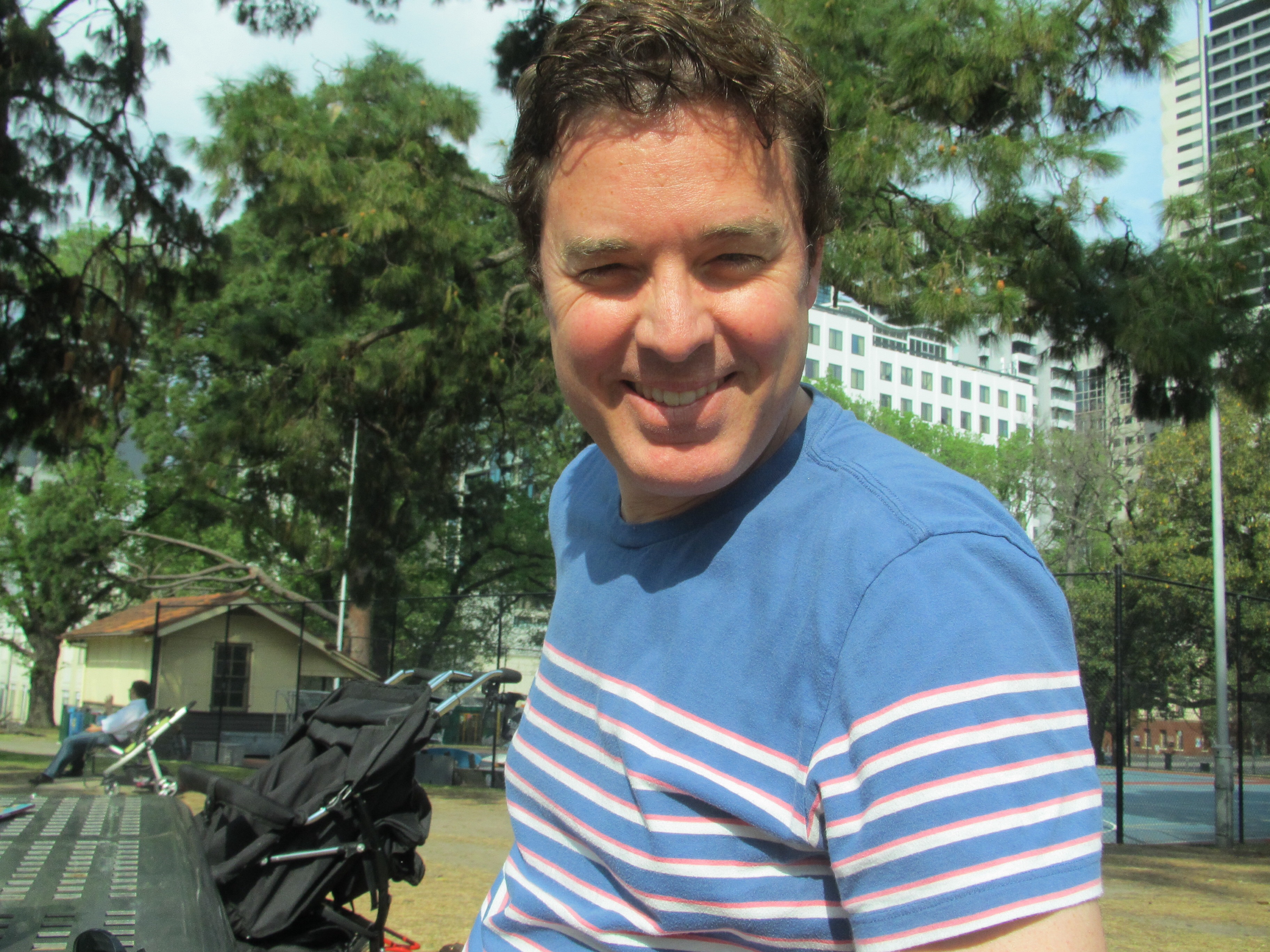
Daddy at Flagstaff Gardens picnic
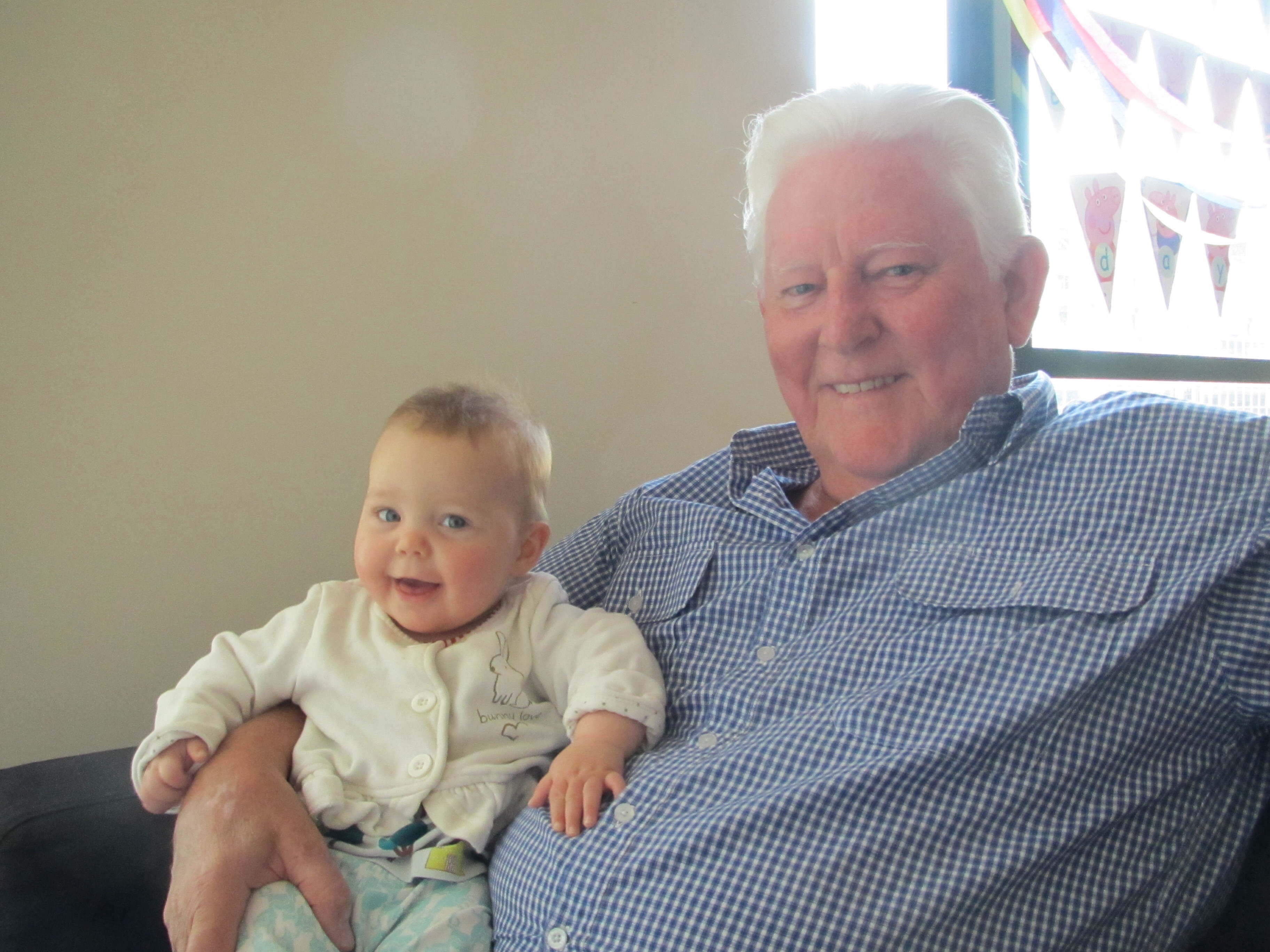
Who is a very lucky Grandpa?
Everyone ends up in grandma's featherbed.
Everyone ends up in grandma’s featherbed.
Grandma on the way to the swings up the road in Northcote